

Yesterday, we learned how to get a specific item using /items/{item_id}. But what if we want to see a list of items and filter them? That’s where Query Parameters shine.
1. What are Query Parameters?
Query parameters are key-value pairs that appear after the ? in a URL. In FastAPI, any function argument that is not part of the path is automatically interpreted as a query parameter.
from fastapi import FastAPI

app = FastAPI()

# 'skip' and 'limit' are query parameters
@app.get("/items/")
async def read_items(skip: int = 0, limit: int = 10):
    return {"skip": skip, "limit": limit}
2. Making Parameters Optional
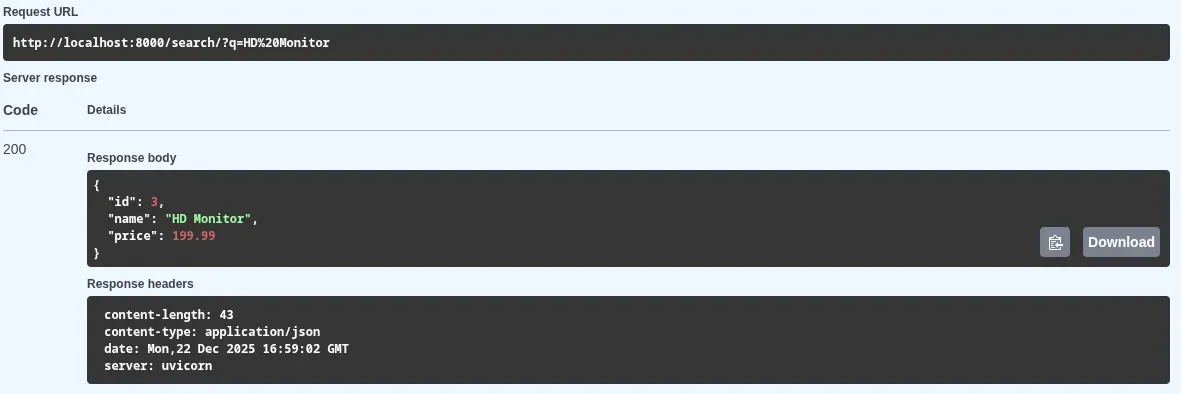
FastAPI uses Python type hints to decide if a parameter is required. By providing a default value (like None), the parameter becomes optional.
@app.get("/search/")
async def search_items(q: str | None = None):
    return {"query": q} if q else {"query": "No search provided"}
🛠️ Implementation
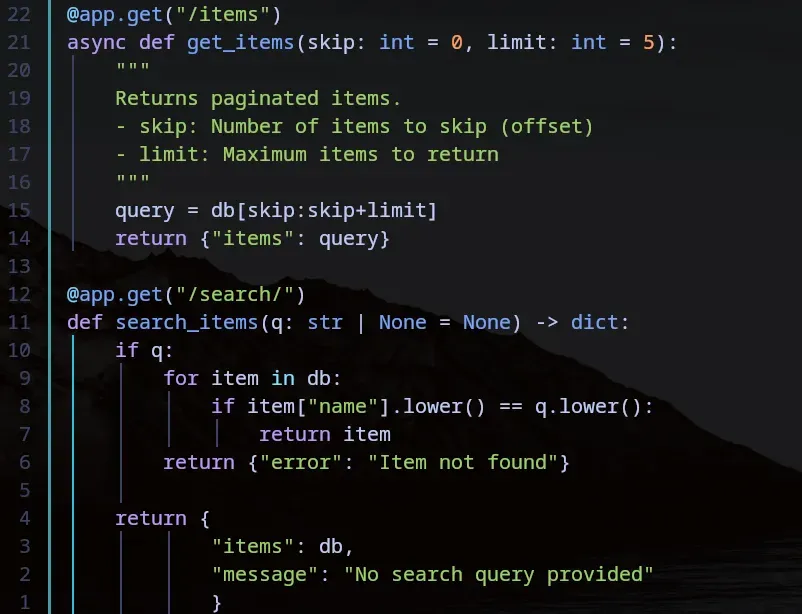
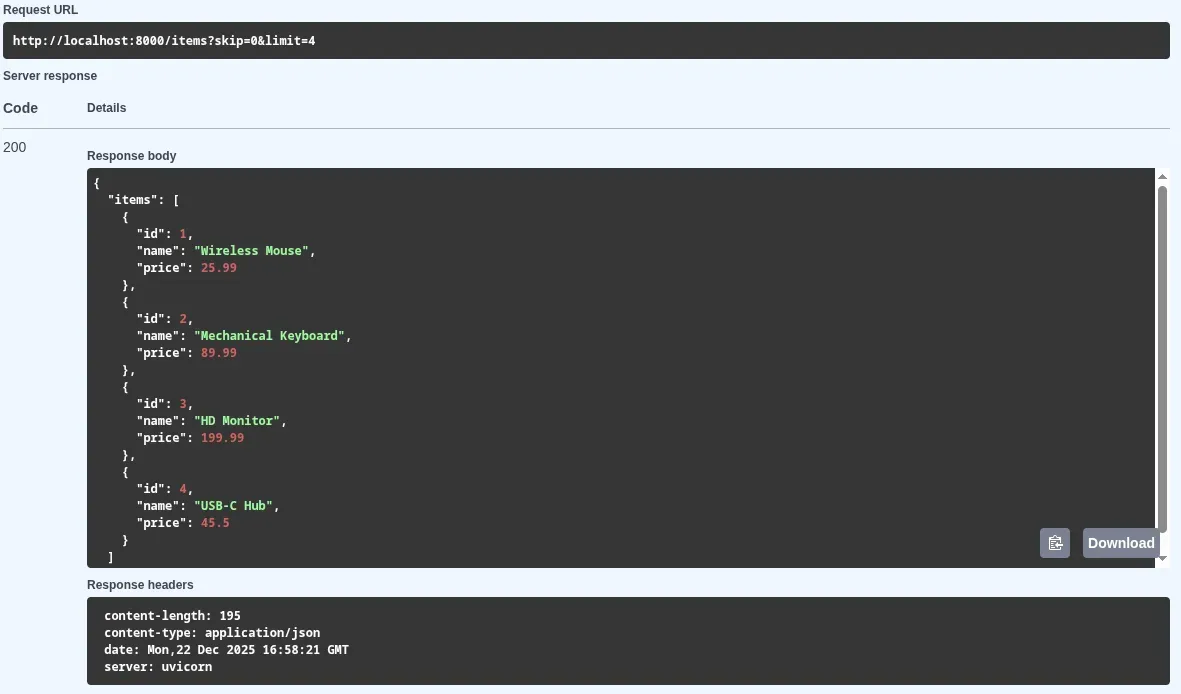
Today I updated my project to handle basic pagination. By using uv run, I kept my environment isolated and my uv.lock file updated as I experimented with different logic.
Checklist:
- Created an endpoint with multiple query parameters.
- Verified that Swagger UI (
/docs) handles boolean toggles correctly. - Confirmed type validation is working for numeric queries.
In FastAPI, path and query parameters serve distinct roles in defining how data is captured from a URL and processed by the application. While path parameters are typically used to identify a specific resource, query parameters are generally used for filtering, sorting, or pagination.
Path Parameters
- Definition and Syntax: Path parameters are dynamic parts of a URL path, defined in the path operation decorator using curly brackets (e.g.,
@app.get("/items/{item_id}")). - Requirement: These parameters are mandatory; if the client does not provide a value at the specified position in the URL, the route will not match, often resulting in a “404 Not Found” error.
- Use Case: They are primarily utilized to locate or retrieve a specific resource within a collection, such as a user by their ID or a book by its title.
- Validation: FastAPI provides a
Path()class to declare metadata and add numeric or string validations (such asmin_lengthorgefor “greater than or equal to”) specifically for these parameters.
Query Parameters
- Definition and Syntax: Query parameters are key-value pairs appended to the end of a URL after a question mark (
?) and separated by ampersands (&). They are not declared in the path decorator but are included as arguments in the path operation function. - Optionality and Defaults: Unlike path parameters, query parameters can be optional. You can define default values for them in the function signature; if the client omits them from the URL, FastAPI will automatically use the specified default.
- Use Case: They are ideal for refining or customizing a response, such as providing optional filters, searching by keyword, or managing pagination (e.g.,
?skip=0&limit=10). - Validation: The
Query()class is used to apply advanced constraints, such as Regular Expressions (RegEx) or range limits, while also allowing developers to add metadata like titles and descriptions for automated documentation.
Key Comparisons
| Feature | Path Parameters | Query Parameters |
|---|---|---|
| Location | Part of the URL path itself. | Appended after the ? in the URL. |
| Requirement | Always mandatory. | Can be optional with default values. |
| Primary Purpose | Resource identification. | Filtering, sorting, and pagination. |
| FastAPI Tool | The Path() class. | The Query() class. |
Analogy: Imagine a large library. A path parameter is like the unique call number on the spine of a specific book; you need it to point exactly to that one item on the shelf. A query parameter is like asking the librarian for “all history books” or “only books published after 2010”; it doesn’t change which library you are in, but it filters the results you see.
📚 Resources
- Documentation: FastAPI Query Parameters Tutorial
- Course: FastAPI – FreeCodeCamp
- Book: FastAPI: Modern Python Web Development (Bill Lubanovic).